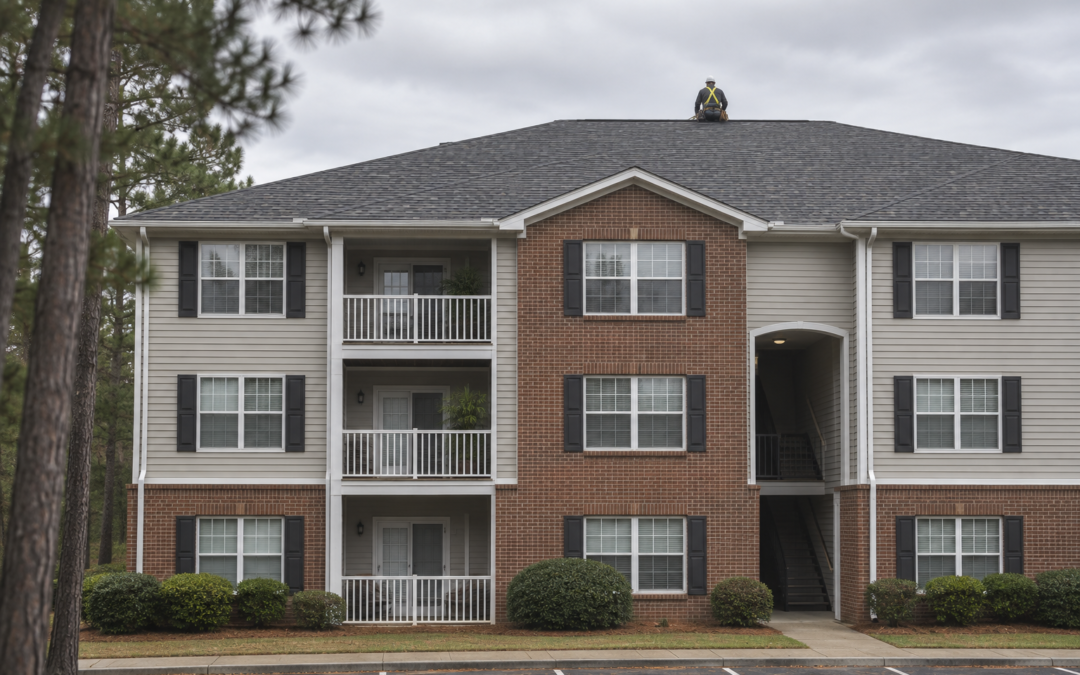
Multi-family roof repair in North Carolina means balancing occupied buildings, board approvals, and a climate that moves quickly from summer humidity to winter ice. If you manage apartments, townhomes, or a condo community, this guide covers the warning signs worth acting on, how to decide between repair and full replacement, what a realistic timeline looks like for a building with residents inside, and what credentials to verify before a contractor sets foot on your property.
Warning Signs Worth Acting On in Multi-Family Roofs
The most urgent signal is active water entry into a unit. If a resident reports a ceiling stain, water running down an interior wall, or bubbling paint, that building already has a breach. Staining alone doesn’t confirm the roof is the source; it could be a plumbing line above the unit or condensation on HVAC ductwork. Even so, rule out the roof first. Water migrates along framing and decking (the structural wood panels nailed to the rafters) before it drips on a ceiling, and it can travel several feet from the original entry point.
Signs you can observe from the ground or the parking lot:
- Granule loss on asphalt shingles. Granules are the grit-like mineral coating on a shingle’s surface. They shield the asphalt layer from UV radiation. When granules wash off in volume, the asphalt dries out and cracks faster. You’ll often spot granule accumulation in downspout splash blocks. For a deeper look at why granules matter, the importance of shingle granules post explains how they affect shingle lifespan.
- Shingles that are curling, cupping, or missing entirely. Curling at the edges (cupping) or upward from the center (clawing) means the shingle is near the end of its useful life.
- Visible sagging along a roof ridge or at mid-span. A ridge that dips or a section that looks soft often means the decking beneath has absorbed water and softened.
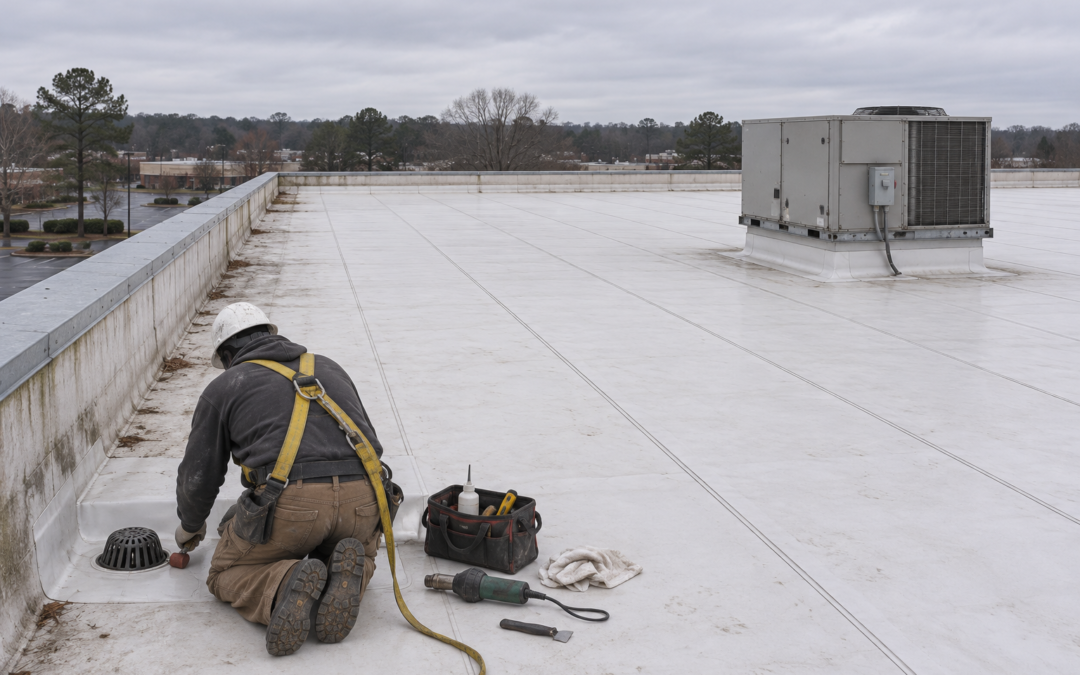
- Rust streaks or staining around metal penetrations. Penetrations are any place something passes through the roof: plumbing vents, HVAC curbs, exhaust fans. The metal flashing (thin metal strips that seal the joint between a penetration and the roofing material) tends to fail before the field shingles do.
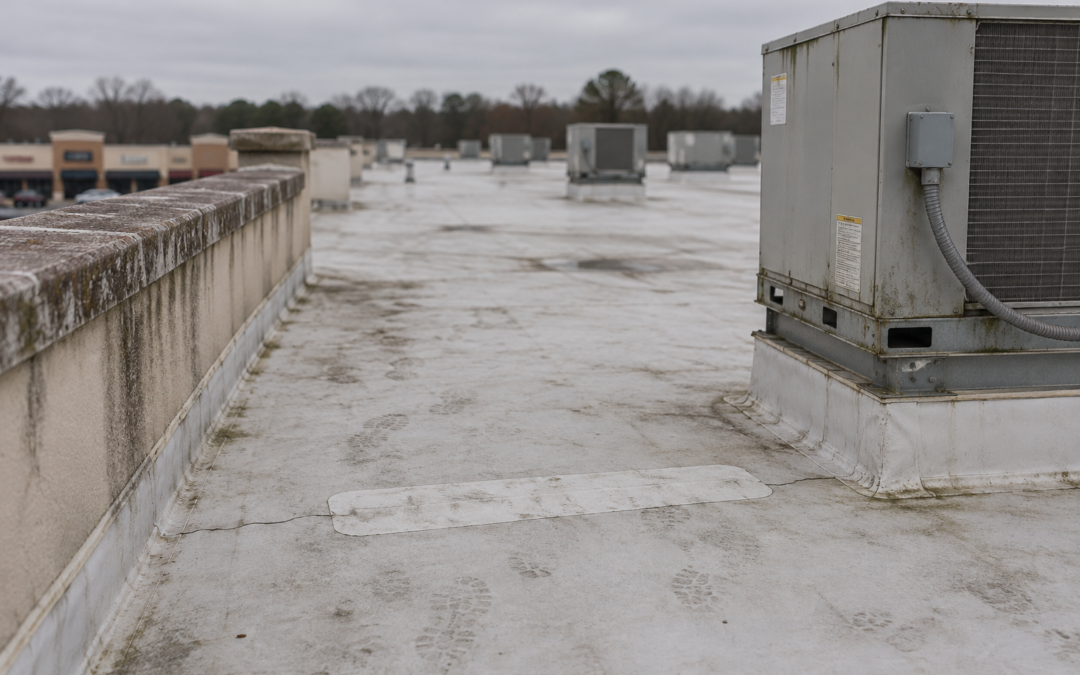
- Ponding water on low-slope sections. Many multi-family buildings combine a steep-slope shingle roof over the main structure with a low-slope section over a breezeway, garage, or addition. Water that sits on a low-slope membrane (the waterproof layer covering a nearly flat roof) for more than 48 hours accelerates deterioration.
- Blistering or bubbling on TPO or EPDM membranes. TPO (thermoplastic polyolefin) is a white or light-grey single-ply sheet commonly used on low-slope roofs. EPDM (ethylene propylene diene monomer) is a black rubber membrane with a long track record on flat sections. Blistering on either material means moisture or air is trapped beneath the membrane.
For a broader look at what roof inspections involve for commercial and multi-family properties, the roof inspections page on our site describes the process in more detail.
Repair vs. Replace: How to Frame the Decision for a Board or Owner
Repair is usually the right answer when the roof system still has meaningful life left and the problem is confined to a specific section or penetration. Full replacement becomes the right conversation when repair costs are recurring, the membrane or shingle field is broadly deteriorated, or the building’s capital plan is approaching the age threshold for the system.
A few practical benchmarks:
Age of the Roof System
Asphalt shingles in North Carolina typically last 20 to 30 years, depending on ventilation, pitch, and tree cover. The National Roofing Contractors Association is a reliable reference for general system life expectancies across material types. TPO and EPDM membranes commonly last 15 to 25 years with routine maintenance.
If a roof is within five years of that age threshold and you’re looking at a repair covering more than 25 to 30 percent of the total surface area, replacement often costs less over a ten-year horizon than layering repairs on a system that’s running out of time.
Frequency of Repairs
If the same section of a building has been patched more than twice in a three-year window, that’s usually a sign of systemic failure rather than isolated damage. Document every repair with photos and work orders. That paper trail helps a board understand the total cost of deferral and also supports any insurance documentation the property may need.
Condition of the Decking
An inspection that finds soft or rotted decking changes the math. Replacing decking adds labor and material cost to any re-roofing project. If decking damage is widespread, a repair-only approach won’t stop the deterioration, because water has already compromised the structural layer beneath the surface.
According to the Insurance Institute for Business and Home Safety, moisture intrusion into structural roof components is one of the leading drivers of elevated repair costs in multi-family buildings. That’s why early detection matters.
North Carolina Code Context
The North Carolina State Building Code requires a permit for most full re-roofing projects on multi-family buildings. Some repair scopes also require a permit depending on square footage and system type. Your contractor should pull the permit. If they suggest skipping it, that’s a reason to find a different contractor. The NC Licensing Board for General Contractors maintains contractor license lookups and can confirm whether a roofing contractor holds a valid license for the scope of work you’re considering.
Multi-Family Roof Repair North Carolina: Realistic Timeline for Occupied Buildings
Scheduling roof work on a building where people live or run a business is different from a single-family home project. Here is a realistic sequence for a mid-size multi-family re-roof or significant repair:
- Inspection and documentation. A thorough inspection of a building with 20 to 50 units typically takes two to four hours. The contractor should photograph every penetration, every flashing detail, any visible decking, and all drainage points. This becomes your baseline record.
- Scope and estimate. A written scope, broken out by area and system, lets a board compare proposals on the same basis. Vague proposals such as “repair the roof as needed” create disputes after the job. Ask for line items.
- Board or ownership approval. For HOA communities, most governing documents require a board vote for expenditures above a certain threshold. Build two to four weeks into the schedule for this step.
- Permit application. Once work is approved, the contractor applies for the permit. In most Triangle-area jurisdictions, permit turnaround for a commercial or multi-family project runs one to three weeks, though timelines vary by jurisdiction.
- Resident notification. Give residents at least 72 hours’ notice before work begins, and again the morning of. Noise, debris nets, and dumpster placement should be explained in advance. Identify any units that may need temporary access or parking adjustments.
- Active construction. A repair on a single building section can often be completed in one to three days. A full re-roof on a larger structure may run one to two weeks, depending on crew size, weather holds, and decking replacement needs.
- Inspection and closeout. The permit inspection, final punch-list walk, and cleanup documentation should happen before final payment. Keep the permit card and final inspection sign-off with your property maintenance records.
For more on how to structure the scheduling conversation with a contractor, the When to Schedule Commercial Roof Repairs post covers timing strategy in more detail.
North Carolina Climate and What It Does to Multi-Family Roofs
North Carolina’s climate creates specific stress patterns that matter for multi-family properties. Understanding them helps you plan maintenance and spot early problems before they become expensive ones.
Summer heat and humidity accelerate granule loss on south- and west-facing slopes. Attic temperatures in poorly ventilated structures can exceed 140°F, which shortens shingle life from the underside out. The Insurance Institute for Business and Home Safety publishes research on how ventilation and attic temperature affect roofing system performance.
Ice damming is less common in the Triangle than in the mountains, but it does occur during hard freezes. An ice dam forms when heat escaping through the roof deck melts snow near the ridge, and the water refreezes at the cold eave. The resulting ice backs up under shingles and forces water into the structure. Buildings with inconsistent attic insulation or air sealing are most vulnerable.
Wind events and tropical remnants push through the region from June through November. The National Weather Service provides historical storm data for North Carolina that can support insurance documentation if you need to establish that a weather event caused specific damage.
Tree canopy proximity is a consistent factor in multi-family settings. Overhanging branches hold moisture against the roof surface, accelerate moss and algae growth, and deposit debris that blocks gutters and drains. Algae staining is cosmetic at first, but it can degrade a shingle’s surface coating over time if left unaddressed. Keeping gutters clear is an easy step that protects both the roof and the fascia board beneath it; the roof maintenance page outlines a practical upkeep routine.
What to Look for in a Multi-Family Roofing Contractor
Not every roofing contractor is set up to handle the coordination, documentation, and communication that a multi-family project requires. Here are the questions worth asking before you sign anything:
- Is the contractor licensed in North Carolina for this scope of work? Verify at nclbgc.org.
- Do they carry general liability and workers’ compensation insurance? Ask for certificates naming your HOA or management company as an additional insured. This protects the association if a worker is injured on the property.
- Can they provide references from comparable multi-family projects? A contractor experienced with single-family homes may not understand permitting, resident communication, or phased scheduling on a larger structure.
- Do they pull their own permits? A contractor who asks you to pull the permit, or who suggests skipping one, is transferring liability to your organization.
- What is the payment structure? A contractor who requires a large deposit before work begins is a flag. Reputable contractors in this market generally collect payment in stages tied to work completion, or upon project closeout.
- What warranty does the labor carry? Manufacturer warranties cover materials; a labor warranty covers installation defects. Ask for both in writing.
Wilson & Sons Roofing is family-owned and has been roofing in Raleigh and across the Triangle since 1996. The company is CertainTeed ShingleMaster and GAF Certified, carries a 20-year labor warranty, and does not require a deposit to start. For a broader look at our commercial and multi-family work, visit the commercial roofing page.
Frequently Asked Questions
How do I know if a multi-family roof needs repair or full replacement in North Carolina?
If the roof is more than 20 years old, has recurring leaks in multiple areas, or has soft or rotted decking, replacement is usually the more cost-effective path. If the system still has significant life remaining and the problem is confined to a specific section or penetration, a targeted repair is often the right call. An in-person inspection is the only reliable way to tell which applies to your property.
Does an HOA or property management company need a permit for roof work in NC?
Yes, in most cases. North Carolina requires a permit for re-roofing on multi-family structures, and some repair scopes also require one depending on the jurisdiction and square footage involved. The contractor you hire should apply for and pull the permit. If they suggest skipping it, that is a significant liability risk for your association.
How long does multi-family roof repair typically take in North Carolina?
A focused repair on a single building section usually takes one to three days. A full re-roof on a larger multi-family structure can take one to two weeks, depending on crew size, weather holds, and whether decking replacement is needed. Add two to four weeks for board approval and one to three weeks for permit processing before the work itself begins.
Can residents stay in their units during a roof repair or replacement?
In most cases, yes. Roofing work does not normally require residents to vacate unless the decking is so compromised that the contractor needs interior access, or if significant structural repair is involved. Property managers should notify residents at least 72 hours in advance and again the morning work starts, covering noise, dumpster placement, and any parking changes.
What is the difference between TPO and EPDM, and which is better for a North Carolina building?
TPO (thermoplastic polyolefin) is a white or light-grey single-ply membrane commonly used on low-slope commercial and multi-family roofs. EPDM (ethylene propylene diene monomer) is a black rubber membrane with a long track record on flat or low-slope sections. Neither is universally better. TPO’s reflective surface reduces cooling loads in hot climates, which matters on a large flat section during a North Carolina summer. EPDM has a longer performance history across a wider range of climates. The right choice depends on the existing system, the building’s drainage design, and what the original installation used.
What should a property manager document before calling a roofer about multi-family roof damage?
Note which units or buildings reported the problem, when it was first observed, and any visible interior symptoms such as ceiling stains, peeling paint, or mold odor. Photos from inside the affected units and from the ground outside are helpful. If the damage followed a storm, note the date and check the National Weather Service for wind speed and precipitation data from that event. That documentation supports your contractor’s inspection and may be useful if the damage is covered under your property’s insurance policy.
Ready to get a clear picture of what your multi-family roof actually needs?
Wilson & Sons Roofing has been working with property managers and HOA boards across the Triangle since 1996, and we’ll give you a straight answer on repair versus replacement, with documentation you can take to your board.
Get your quote, no cost, no hassle or call us at (919) 787-3253.