If water is showing up inside your North Carolina commercial building, the right question isn’t how fast you can get a crew on the roof. It’s whether you need a targeted repair, a coating, or a full replacement. Low-slope roof repair in North Carolina is worth doing when damage is isolated; when it isn’t, spending money on repairs that won’t hold costs more in the long run.
How Low-Slope Commercial Roofs Work in North Carolina
Low-slope roofs, sometimes called flat roofs, are built with a very slight pitch so water drains toward internal drains or scuppers (openings in the parapet wall that let water off the roof). They don’t shed water the way a steep residential shingle roof does, so the membrane, the waterproof layer covering the entire roof deck, does all the work.
North Carolina’s climate is hard on these membranes. The National Weather Service tracks the Triangle region as averaging over 45 inches of rain per year. Add significant UV exposure in summer and freeze-thaw cycles in winter, and you have conditions that degrade seams, flashings, and membrane surfaces faster than a dry climate would.
According to the Insurance Institute for Business and Home Safety, rooftop drainage failures and membrane seam failures are among the most common causes of water intrusion in commercial buildings. Knowing your membrane type is the first step toward knowing what to expect.
The three most common membrane types on NC commercial buildings are:
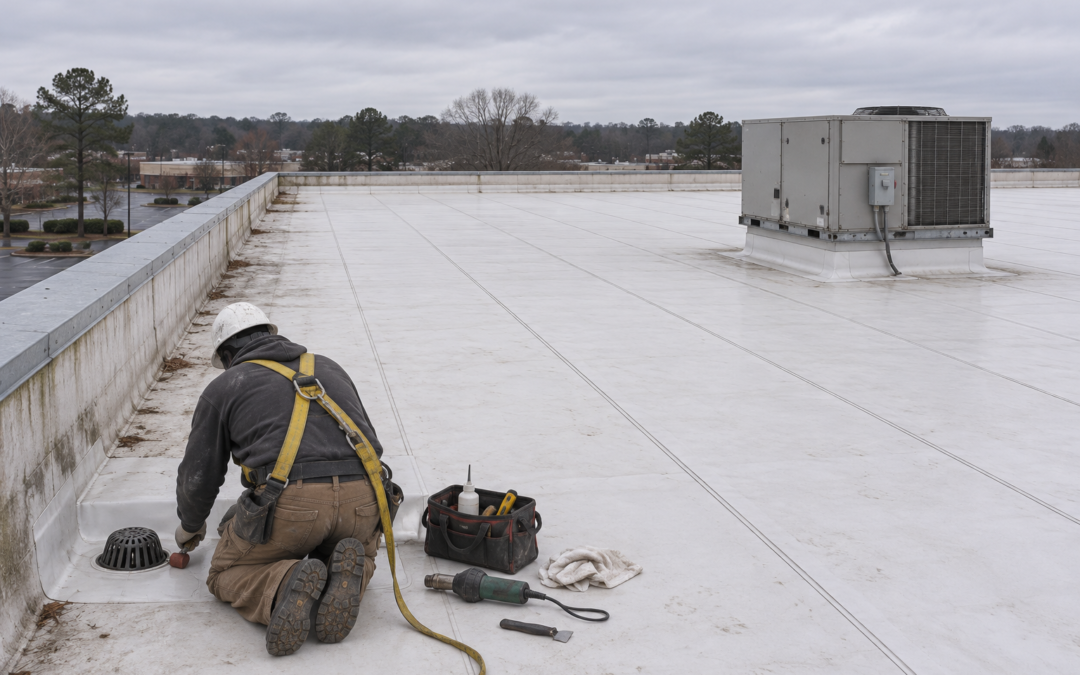
- TPO (thermoplastic polyolefin): A white or light-colored single-ply sheet welded at the seams. Reflects heat well, which matters in NC summers.
- EPDM (ethylene propylene diene monomer): A rubber membrane, usually black or white. Flexible and durable; common on older buildings.
- Modified bitumen: A multi-layer asphalt system, often topped with a granulated surface. Similar chemistry to shingles but designed for low-slope application.
Each system ages differently and has a different repair threshold. That matters when you’re deciding whether to repair or replace.
The Core Decision: Repair, Restore, or Replace
Most experienced contractors use a rough guideline for low-slope roof repair in North Carolina: if less than 25% of the roof membrane is damaged or water-saturated, targeted repairs are usually worth doing. If the damage is widespread, or if the insulation beneath the membrane has absorbed water (called wet insulation), the economics often shift toward full replacement.
That 25% figure isn’t arbitrary. The National Roofing Contractors Association notes that repairs on a membrane with broad underlying moisture damage tend to fail again quickly. Wet insulation keeps a new patch from bonding correctly and continues to degrade the deck beneath it.
Signs That Repair Is the Right Call
- Leaks trace back to one or two locations, usually a seam, a drain collar, or flashing around a rooftop unit
- The membrane is otherwise in good condition, with no widespread cracking, blistering, or ponding zones
- The roof is less than 15 years old
- A core sample (a small plug pulled from the membrane by a roofer) shows dry insulation beneath the damaged area
- Maintenance records show the roof has been inspected and serviced regularly
Signs That Replacement Is the Right Call
- Leaks appear in multiple unconnected locations after a single rain event
- Core samples reveal wet or compressed insulation across large areas
- The membrane surface is chalking, cracking, or shrinking broadly, not just at a seam
- The roof is 20 years old or older and has never had significant work
- Ponding water (water that sits on the roof more than 48 hours after rain) covers large sections, which signals that the deck may have deflected
- Previous repairs have failed repeatedly in the same spots
What About Roof Coatings?
A roof coating is a liquid-applied layer, usually silicone, acrylic, or polyurethane, that gets rolled or sprayed over an existing membrane to extend its life and improve reflectivity. Coatings are sometimes called a restoration system.
They work well under specific conditions. The ENERGY STAR program recognizes reflective roof coatings for reducing cooling loads, and the energy savings in an NC summer can be meaningful. But a coating is not a repair tool. It seals a sound membrane against future weathering; it doesn’t fix a membrane that is already failing or insulation that is already wet.
A coating makes sense when:
- The membrane is structurally intact but showing surface oxidation or minor porosity
- Core samples confirm the insulation is dry throughout
- The roof has at least several years of remaining service life
- The goal is to extend the roof another 10 to 15 years without full tear-off costs
A coating does not make sense when:
- There is active ponding that the coating will trap rather than seal around
- Seams are splitting or the membrane is shrinking at the edges
- Wet insulation has been confirmed by moisture testing
How to Assess Your NC Commercial Roof
Property managers rarely need to get on the roof themselves. Walking a commercial low-slope roof without training can damage the membrane. Here’s what you can do from the ground and from inside the building.
- Walk the interior. Look at ceiling tiles, the decking, and any exposed structural steel for water stains, rust streaks, or active drips. Note their location relative to the roof plan.
- Check the drains after rain. Look from ground level or through roof access hatches to see whether drains are clear. Clogged drains create ponding, one of the leading causes of membrane failure on NC commercial buildings.
- Review maintenance records. When was the last professional inspection? Have the same areas been repaired before? A history of repeat repairs in one spot is useful data.
- Schedule a moisture scan. A qualified roofer can use infrared scanning or nuclear moisture meters to map wet insulation without cutting through the whole roof. This is the most reliable way to know how widespread the saturation is before committing to a budget.
For more detail on what a scheduled inspection covers, see our roof inspections page. Our post on the importance of commercial roof maintenance also covers what a routine service program looks like.
Roof Age and Remaining Service Life
Age alone doesn’t tell the whole story, but it sets context. According to the National Roofing Contractors Association, a well-maintained TPO roof typically lasts 20 to 30 years, EPDM systems have similar lifespans when seams are kept intact, and modified bitumen systems typically run 15 to 25 years. Actual service life varies with installation quality, maintenance history, and rooftop equipment loads.
If your roof is at or past its expected lifespan and you’re seeing active leaks, the repair math changes. Spending significant money on a membrane with two or three years of life remaining rarely makes financial sense. Full replacement with a new warranted system usually costs less over the next decade than repeated emergency repairs on a failing roof.
If the roof is mid-life, say 8 to 12 years old, with isolated damage, targeted repair is almost always the right first step.
Working with Your Board or Ownership Group
Property managers often have to present a repair-versus-replace recommendation to an HOA board, an asset manager, or an ownership group that isn’t familiar with roofing systems. A few things make that conversation easier:
- Get a written inspection report with photographs, not just a verbal quote
- Ask the contractor to include moisture scan results and explain what percentage of the roof is affected
- Request separate line-item estimates for repair only, coating only (if applicable), and full replacement, so the board can compare options against the roof’s remaining life
- Ask about phasing: on very large roofs, some replacement projects can be staged over two budget cycles
Wilson & Sons Roofing documents damage with photos and written estimates and can meet with an insurer’s adjuster on site if a storm claim is involved. The claim itself belongs to the building owner. For multi-family communities, our multi-family roof repair guide for NC HOAs and property managers covers coordination and scheduling in more detail.
What Low-Slope Repair and Replacement Costs in North Carolina
Specific pricing for your building requires an in-person inspection. Square footage, membrane type, insulation depth, number of rooftop penetrations (vents, HVAC units, skylights), and tear-off requirements all affect the final number. For general market context, the National Roofing Contractors Association publishes industry data on commercial roofing costs, though those figures shift with material prices each year.
What holds steady across projects is the relationship between options. Targeted repairs cost a fraction of full replacement. Coatings fall in between. Full replacement costs the most upfront but often the least per year when spread over a 20-year service life. An honest contractor will show you all three options and let the inspection data drive the decision.
For a broader look at how contractors approach low-slope systems in this region, see our low-slope roof repair and installation guide for Raleigh, NC.
Frequently Asked Questions
How do I know if my NC commercial roof needs repair or full replacement?
The clearest signal is how widespread the damage is. Isolated leaks at seams or drains usually call for repair. Leaks in multiple unconnected locations, failed past repairs, or wet insulation confirmed by moisture scanning usually point toward replacement. A professional inspection with a moisture survey gives you the most reliable answer before you commit a budget.
Can a roof coating replace a full low-slope roof replacement in North Carolina?
A coating can extend the life of a sound membrane, but it can’t fix a roof that is already failing structurally or has wet insulation beneath it. Applying a coating over wet insulation traps moisture and accelerates deck damage. If your roof passes a moisture scan and the membrane is intact, a coating may be a cost-effective option. If not, coating over the problem makes it worse.
How long does a TPO or EPDM roof last in North Carolina?
A well-maintained TPO or EPDM membrane in North Carolina typically lasts 20 to 30 years, according to the National Roofing Contractors Association. North Carolina’s UV intensity and summer heat can shorten that range if the roof isn’t inspected and maintained regularly. Annual inspections and prompt seam repairs are the two things that most reliably extend service life.
What is ponding water and why does it matter on a low-slope commercial roof?
Ponding water is water that remains standing on a roof surface more than 48 hours after rain stops. It matters because prolonged standing water breaks down membrane surfaces faster, adds structural load to the deck, and signals that drainage may be blocked or that the deck has deflected (sagged slightly). Keeping drains clear is the simplest way to prevent it.
Does Wilson & Sons Roofing handle commercial low-slope roofs across North Carolina?
Wilson & Sons Roofing is based in Raleigh and serves commercial properties throughout the Triangle region and surrounding NC communities. The team works with property managers, HOA boards, and business owners on TPO, EPDM, and modified bitumen systems. You can learn more on the commercial roofing page.
Is it safe to walk on a commercial low-slope roof to check for damage?
Property managers and building owners should not walk a low-slope membrane roof without a qualified roofer present. Foot traffic on a TPO or EPDM membrane, especially near seams, can create punctures that aren’t visible until the next rain. Interior ceiling checks, drain observations from roof hatches, and a scheduled professional inspection are the safer way to gather the information you need.
Ready to get a straight answer on your NC commercial low-slope roof?
Wilson & Sons Roofing has been inspecting and repairing low-slope commercial roofs across the Triangle since 1996, and we’ll tell you plainly whether repair, coating, or replacement is the right move for your building.
Get your quote, no cost, no hassle or call (919) 787-3253 to schedule an inspection.