Gutter guards in Raleigh, NC cost anywhere from under a dollar to more than ten dollars per linear foot installed, depending on the material and the complexity of your roofline. Most homeowners want to know three things before they buy: what type actually works in a yard full of pine needles and oak leaves, what it will cost for their specific house, and whether the investment holds up over time. This post answers all three.
What Gutter Guards Actually Do (and Don’t Do)
A gutter guard is a cover or insert that sits over or inside your gutter channel to keep debris out while letting rainwater flow through. The goal is to reduce how often you need to clean your gutters, not to eliminate maintenance entirely. Even the best guards need an occasional rinse or inspection, because fine debris like pine pollen and seed pods can still collect on top of the cover or work their way into the channel.
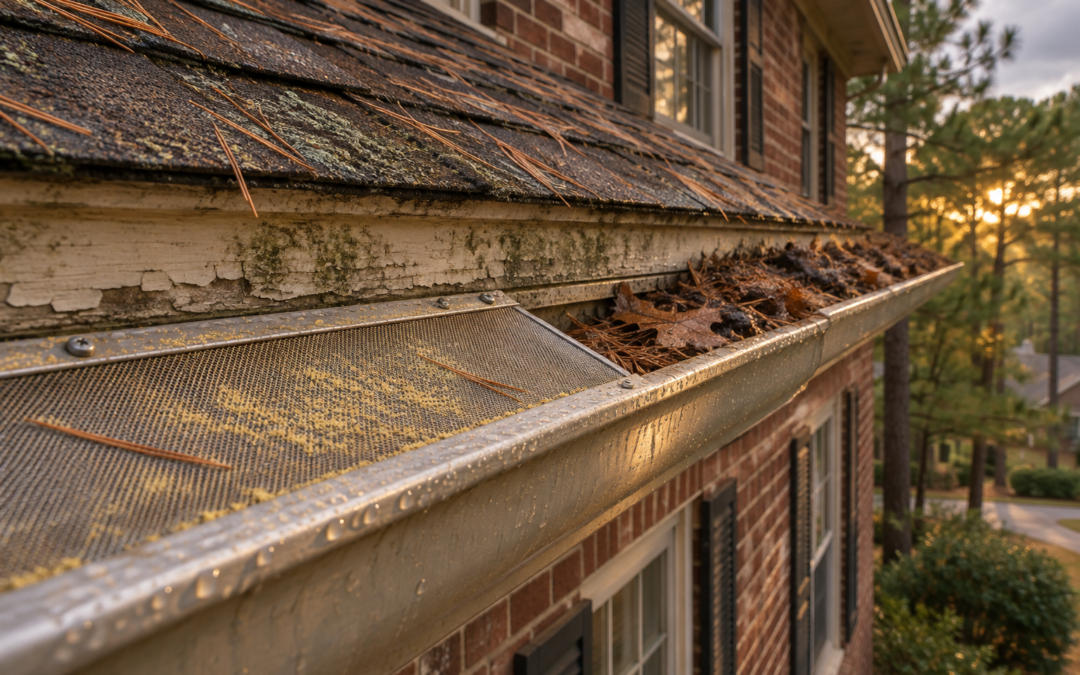
Raleigh sits in a mixed forest zone with heavy oak, pine, and sweet gum coverage in many neighborhoods. That mix of large leaves, pine needles, and sticky seed pods is harder on gutters than a region with one dominant tree type. A guard that performs well in a neighborhood with only maple trees may clog quickly on a lot surrounded by longleaf pines.
Uncleaned gutters pull water toward your fascia (the flat board that runs along the lower edge of the roof), your soffit (the underside of the roof overhang), and your foundation. The National Roofing Contractors Association considers proper drainage one of the most important factors in protecting a home’s structure over time.
How Gutter Guard Installation Works in Raleigh, NC
Installation method varies by guard type, but the general process for a professional crew follows these steps:
- Clean the existing gutters thoroughly. Guards installed over debris trap moisture against the gutter wall and speed up rust or rot.
- Inspect the gutters and fascia for damage, sagging, or improper slope. A guard on a sagging gutter still drains poorly.
- Fit and cut the guards to match each run, including corners and downspout openings.
- Secure the guards according to the manufacturer’s method: some clip to the gutter lip, some slide under the first course of shingles (the bottom row), and some attach with screws.
- Test the flow by running water from a hose to confirm drainage reaches each downspout.
The crew does this work from ladders and from the ground. You don’t need to go on the roof, and you shouldn’t.
The 5 Main Types of Gutter Guards
Mesh or Micro-Mesh Guards
Micro-mesh guards are a fine metal screen, usually stainless steel, stretched over a frame that sits across the top of the gutter. The holes are small enough to block pine needles and seed pods while letting water sheet through. Consumer Reports and industry reviewers consistently rank micro-mesh as one of the more effective designs for mixed debris. They’re also among the more expensive options.
Reverse-Curve (Surface Tension) Guards
These guards curve the water around a solid hood and direct it into a narrow slot. Water clings to the curve by surface tension and drops into the gutter; debris is supposed to fall off the edge. They work well for large leaves but can let pine needles ride the curve and enter the slot. They also require precise installation angle, so professional fitting matters more with this type.
Perforated Aluminum or Steel Covers
A solid panel with punched holes, these snap or screw over the gutter opening. They’re affordable and durable, and they handle large leaves well. The holes are large enough that seed pods and pine needles can still get through, so they work better in a yard with deciduous trees than in a yard with heavy pine coverage.
Foam Inserts
Foam inserts sit inside the gutter channel. Water soaks through the foam; debris sits on top and dries out, then blows away. They’re inexpensive to buy but tend to trap organic matter against the gutter wall, which can accelerate rust and promote moss or mold growth. Most roofing professionals see them as a short-term fix rather than a long-term solution.
Brush Inserts
Similar to foam, brush inserts are cylindrical bristle rolls that sit inside the gutter. Debris theoretically rests on the bristles and blows off. In practice, pine needles and seed pods work their way deep into the bristles and are harder to remove than debris in an open gutter. They’re a reasonable budget option for a home with minimal tree coverage.
What Gutter Guard Installation Costs in Raleigh, NC
Gutter guard cost depends on four main factors: the material you choose, the linear footage of your gutters, the pitch and height of your roofline, and local labor rates.
According to HomeAdvisor’s cost data, gutter guard installation typically runs between $0.50 and $10 or more per linear foot installed nationally, with the mid-range (aluminum mesh or perforated covers) falling around $1 to $4 per linear foot. High-end micro-mesh systems from established brands can run $6 to $12 or more per linear foot installed.
A typical single-story home in Raleigh has roughly 150 to 200 linear feet of gutters. A two-story home with a more complex roofline can have significantly more, and steep pitches or high eaves add to labor time.
Those ranges give you a starting point. The real number for your house comes from an in-person inspection, because two homes on the same street can have very different gutter lengths, roof heights, and existing gutter conditions.
Factors that push cost up:
- Two-story or three-story rooflines (more ladder time and safety setup)
- Steep roof pitches
- Gutters that need cleaning or minor repair before guards go on
- Corners and valleys that require custom fitting
- Premium micro-mesh or reverse-curve systems
Factors that keep cost down:
- Single-story homes with straightforward rooflines
- Existing gutters in good condition
- Simpler insert or perforated-cover products
Are Gutter Guards Worth It for Raleigh Homeowners?
For most homeowners with mature trees on or near their property, the answer is yes, with realistic expectations. Guards won’t eliminate gutter maintenance, but they can cut cleaning frequency significantly and reduce the chance of a clogged gutter causing water damage to your fascia, soffit, or foundation.
The case is strongest if:
- You have several large trees close to your roofline
- Your gutters are in good condition and worth protecting
- You’ve had fascia rot or foundation drainage issues tied to overflowing gutters
- You prefer to reduce how often you need to hire a cleaning crew
The case is weaker if:
- Your home has very little tree coverage and gutters rarely fill with debris
- Your existing gutters are near the end of their life (guards on worn gutters don’t fix the underlying problem)
- You’re choosing the cheapest foam or brush insert primarily to avoid a bigger job now
If your gutters are already showing signs of failure, read How to Know When Your Home Needs New Gutters in NC before adding guards. Installing guards on gutters that need replacing is spending money on the wrong problem.
What to Look For Before Installation
You can check several things safely from the ground or from inside your attic before calling for a quote:
- Look along the roofline for gutters that sag or pull away from the fascia. A healthy gutter sits tight against the fascia board with a slight slope toward the downspout.
- After a rain, watch to see if water spills over the front edge of the gutter rather than flowing toward a downspout. That’s a clogged or undersized gutter, not a gutter-guard problem.
- Check the fascia boards from the ground for dark staining, soft spots, or paint peeling back from the board. Those are signs that water has been sitting in the gutter and backing up against the wood.
- In your attic, look at the roof deck (the plywood or OSB panels nailed to the rafters) near the eaves for water staining or soft spots.
For a fuller picture of what’s happening at the roofline, a roof inspection before gutter work is a reasonable step, especially on a home more than ten years old.
November is a good time to act. Most of the fall leaf drop has happened, so a crew can clean the gutters properly and install guards before winter rain and debris arrive. The winter roof and gutter prep checklist covers the broader picture if you want to get the whole system ready before the cold months.
Frequently Asked Questions
How much does gutter guard installation cost in Raleigh, NC?
Installed cost for gutter guards in Raleigh, NC generally ranges from under $1 to more than $10 per linear foot, depending on the guard type and your roofline. According to HomeAdvisor, most homeowners nationally pay somewhere between $600 and $2,400 for a full installation, though a home with a complex or multi-story roofline can run higher. An in-person measurement of your gutters is the only way to get an accurate number.
Do gutter guards really work, or are they a waste of money?
Gutter guards do reduce debris buildup and cleaning frequency, but no guard eliminates maintenance entirely. Micro-mesh designs tend to perform better against fine debris like pine needles, which are common in Raleigh yards, while perforated covers work well for large leaves. The value depends on how many trees are near your roofline and whether your gutters are in good condition to begin with.
Will gutter guards void my roof warranty?
Some guards that slide under the first row of shingles (the bottom course along the eave) can affect certain manufacturer warranties if they’re not installed correctly. Before choosing a guard system, confirm with your installer whether the attachment method is compatible with your shingle manufacturer’s guidelines. CertainTeed and GAF both publish installation guidance on their websites at certainteed.com and gaf.com.
Can I install gutter guards myself to save money?
Some clip-on mesh products are designed for DIY installation and are sold at home improvement stores. The risk is in the prep work: guards installed over uncleaned gutters or on gutters with improper slope trap moisture and can accelerate damage. Working on a ladder at roofline height also carries real safety risk. For a two-story home or any home with significant tree coverage, professional installation is worth considering.
How often do gutter guards need to be cleaned or maintained?
Even high-quality micro-mesh guards benefit from an annual rinse and visual inspection, particularly in fall after the bulk of leaf drop. Fine debris like pine pollen and seed pod fragments can build up on the mesh surface and slow drainage. Most homeowners with guards find they go from cleaning gutters two or three times a year to once a year or less, though this depends on tree coverage.
What type of gutter guard works best for homes with pine trees?
Micro-mesh guards with small stainless-steel openings are generally the best match for homes with significant pine tree coverage. Pine needles are thin enough to pass through larger perforated covers or ride the curve of a reverse-curve system into the gutter. The finer the mesh, the better it blocks needles while still allowing water to flow through. Installation quality matters too: a micro-mesh guard fitted with gaps or improper slope won’t perform as well as the product’s design allows.
Ready to Talk Through Your Gutter Guard Options?
Wilson & Sons Roofing has been helping Raleigh homeowners protect their gutters and rooflines since 1996, and we’re glad to look at your specific situation before recommending anything.
Get your quote, no cost, no hassle or call us at (919) 787-3253 to set up a free inspection before the winter rains arrive.